
Executive Summary
Material selection defines optical stability in space systems.
Thermal gradients, structural loads during launch, and long-term dimensional stability requirements impose constraints that conventional optical substrates cannot always satisfy. In such conditions, silicon carbide (SiC) offers structural and thermal properties that make it particularly suitable for demanding spaceborne optical systems.
This article outlines the engineering rationale for silicon carbide optics in space applications and explains where reaction-bonded and CVD SiC provide measurable advantages.
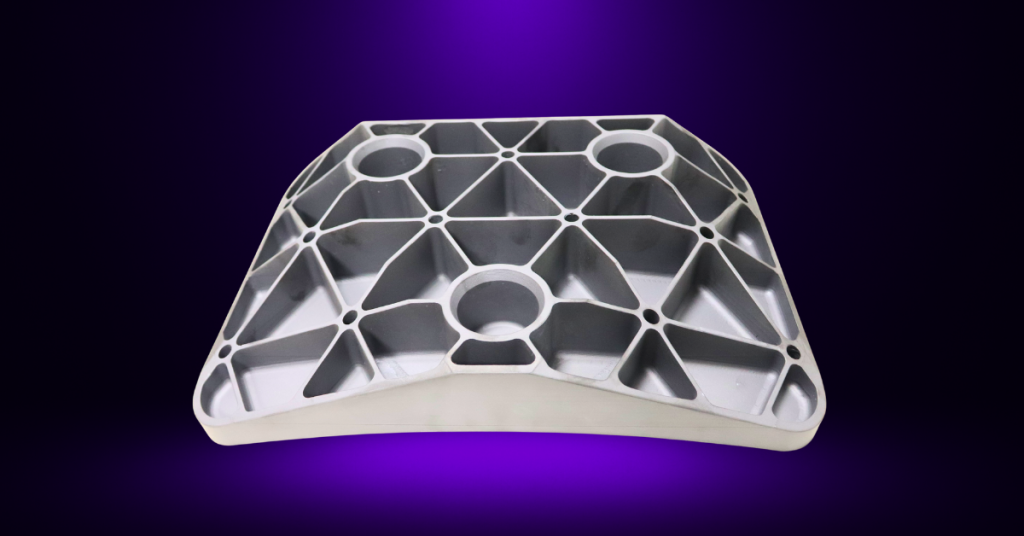
A silicon carbide mirror
Why Structural Stability Matters in Space Optics
Optical performance in orbit is rarely limited by nominal design capability.
It is limited by how optical geometry behaves under:
- Thermal gradients
- Launch vibration and acceleration
- Gravity release effects
- Long-term dimensional drift
An optical substrate must therefore be evaluated not only for surface quality, but for:
- Specific stiffness (E/ρ)
- Coefficient of thermal expansion (CTE)
- Thermal conductivity
- Homogeneity and coating compatibility
Silicon Carbide vs Conventional Optical Substrates
Silicon carbide provides a combination of properties rarely achieved simultaneously:
- High Young’s modulus
- Low density
- High thermal conductivity
- Low CTE
- High specific stiffness
These characteristics enable:
- Reduced structural deformation
- Faster thermal equilibrium
- Improved resistance to thermally induced wavefront error
- Lightweight mirror architectures
For large apertures and thermally dynamic environments, SiC often represents a structurally rational material choice.
Reaction-Bonded SiC vs CVD SiC
Both reaction-bonded (RB-SiC) and chemical vapour deposition (CVD SiC) variants are used in precision optical systems.
Reaction-Bonded SiC
- High structural stiffness
- Suitable for lightweight mirror cores
- Cost-efficient for medium to large apertures
- Strong mechanical robustness
CVD Silicon Carbide
- High material homogeneity
- Superior polishability
- Extremely low surface roughness capability
- Suitable for high-precision optical surfaces
Material selection depends on aperture size, wavefront tolerance, coating requirements, and environmental stability criteria.
Custom Silicon Carbide Mirror Capabilities
We manufacture custom silicon carbide mirrors in the following ranges:
|
Size Range |
25 mm – 800 mm aperture |
|
Surface Shapes |
Flat (typical)SphericalAspheric |
|
Surface Accuracy |
Up to λ/100 RMS |
|
Coating Options |
Aluminium (Al) |
Mirror architectures may include lightweighted back structures for mass reduction while preserving stiffness.
Thermal & Structural Behaviour
The combination of high thermal conductivity and low density allows SiC mirrors to:
- Reach thermal equilibrium rapidly
- Minimise temperature gradients
- Reduce thermally induced deformation
In systems where optical performance must remain stable across wide operational temperature ranges, material behaviour directly influences wavefront stability and long-term repeatability.
Lightweight Silicon Carbide Mirror Applications
Silicon carbide mirrors are particularly suited to:
- Space telescopes
- Earth observation systems
- Laser scanning systems
- Semiconductor and lithography systems
- Defence and high-precision tracking systems
In large-aperture or mass-constrained platforms, SiC enables stiffness levels unattainable with conventional substrates at comparable weight.
Manufacturing with Reproducibility in Mind
Surface quality alone does not define optical reliability.
Manufacturing processes must ensure:
- Repeatable surface accuracy
- Controlled polishing processes
- Coating adhesion stability
- Structural integrity under environmental stress
Precision optical manufacturing requires consistency as much as capability.
When Silicon Carbide Is the Rational Choice
Silicon carbide optics are particularly appropriate when:
- Aperture size increases structural sensitivity
- Thermal gradients drive wavefront error
- Mass reduction is mission-critical
- Long-term dimensional stability is required
Material selection should be driven by quantified system behaviour, not convention.
Silicon Carbide Optical Components & Assemblies
For mission-specific silicon carbide mirrors or optical assemblies, including reaction-bonded and CVD SiC configurations, contact our engineering team.
We provide silicon carbide optics defined by measurable stability and reproducible precision.
Partner with Astravon
Astravon aims to be a trusted engineering partner for optical systems that must perform as intended, throughout their operational life.